

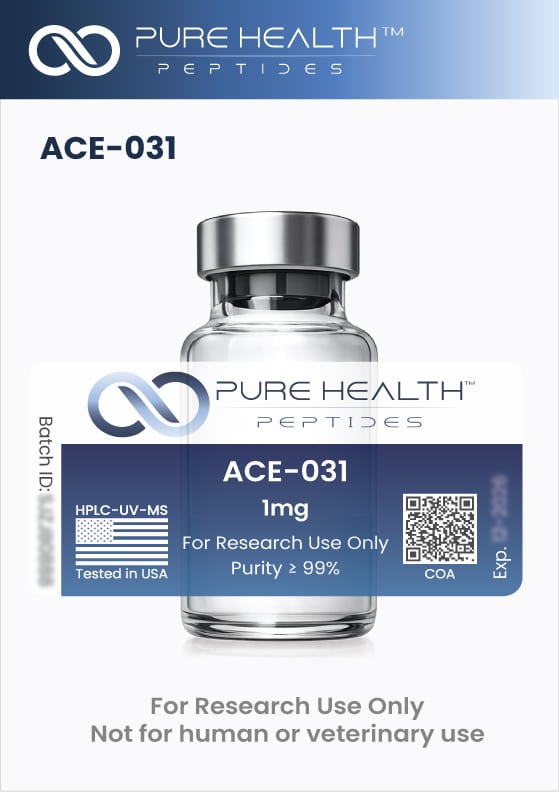
ACE-031 Research Overview
ACE-031 is an experimental biologic that has attracted scientific interest because of its potential effects on muscle regulation. Also known as ramatercept, ACE-031 was investigated for its ability to interfere with biological signals that normally limit muscle growth. Its mechanism made it a subject of research into muscle-wasting conditions, including Duchenne muscular dystrophy (DMD).
For readers researching ACE-031 online, understanding its scientific background, clinical research history, and safety limitations is essential. Although early studies reported changes in certain measures of lean body mass and muscle volume, ACE-031 did not progress to an approved treatment. Its clinical development was discontinued following safety concerns.
This guide provides an evidence-focused overview of ACE-031, explains why researchers investigated it, and identifies important considerations for anyone comparing online product information. It also discusses how to evaluate supplier claims without confusing research materials with approved medicines.
What Is ACE-031?
ACE-031 is a recombinant fusion protein designed to bind myostatin and other related signaling molecules involved in regulating muscle growth. Unlike many compounds marketed broadly as peptides, ACE-031 is a complex biologic fusion protein rather than a conventional short-chain peptide.
Myostatin is a protein that helps regulate skeletal muscle development. Researchers have investigated whether modifying myostatin signaling could provide therapeutic benefits in conditions characterized by muscle weakness or loss of muscle tissue.
ACE-031 was developed to act as a soluble version of the activin receptor type IIB, linked to an immunoglobulin Fc region. This design allows the molecule to interact with certain signaling proteins before they activate their usual cellular pathways.
Scientific publications describe ACE-031 as an investigational compound. It is not an FDA-approved medication for muscle growth, athletic performance, bodybuilding, or any other therapeutic indication in the United States.
How Does ACE-031 Work?
The scientific interest in ACE-031 centers on its interaction with biological pathways involved in muscle regulation.
1. Myostatin Signaling Research
Myostatin acts as a natural regulator of skeletal muscle growth. Researchers have explored whether reducing its activity could help preserve or increase muscle tissue under specific medical circumstances.
ACE-031 was designed to bind myostatin and related ligands. By interacting with these signaling molecules, it was intended to reduce certain inhibitory signals affecting muscle development.
2. Activin Receptor Type IIB
The compound incorporates an extracellular portion of activin receptor type IIB. This component functions as a decoy receptor, binding selected ligands rather than acting like a conventional receptor embedded in a cell membrane.
The approach is scientifically significant because muscle regulation involves several interconnected pathways. However, affecting these pathways can also influence biological processes outside skeletal muscle, which is one reason comprehensive safety evaluation is important.
3. Experimental Muscle-Related Outcomes
Early clinical research examined changes in lean body mass, thigh muscle volume, bone-related measurements, and other biological indicators.
Some findings were encouraging enough to support continued scientific interest in myostatin inhibition as a research strategy. Nevertheless, changes in selected measurements do not establish a safe, effective, or approved treatment.
Researchers must distinguish preliminary biological activity from demonstrated clinical benefits.
ACE-031 Clinical Research: What Studies Found
Published clinical studies provide important context for understanding ACE-031.
A Phase 1 study involving 48 healthy postmenopausal women evaluated the safety, pharmacokinetics, and biological effects of a single dose. Investigators reported increases in measured lean body mass and thigh muscle volume in the highest-dose group at the study’s assessment point.
These results helped establish scientific interest in the compound’s mechanism. However, the study was small, examined a specific population, and was not designed to demonstrate long-term safety or establish a treatment for general muscle development.
A subsequent randomized, placebo-controlled clinical trial evaluated ACE-031 in ambulatory boys with Duchenne muscular dystrophy. The trial investigated safety and explored several potential biological and functional outcomes.
The study was discontinued after safety concerns involving epistaxis, or nosebleeds, and telangiectasias, which are visibly enlarged small blood vessels. Although investigators observed trends in some muscle-related measurements, the findings did not establish a clinically meaningful treatment benefit.
These findings highlight a critical point: a compound can demonstrate biological activity without becoming a viable medicine.
For further reading, see the published clinical studies:
- Attie et al., A single ascending-dose study of muscle regulator ACE-031 in healthy volunteers. Read the study on PubMed.
- Campbell et al., Myostatin inhibitor ACE-031 treatment of ambulatory boys with Duchenne muscular dystrophy. Read the clinical trial publication.
Potential Research Applications of ACE-031
ACE-031 was investigated primarily in connection with muscle regulation and potential treatment approaches for muscle-wasting conditions.
Muscle Biology
The compound’s interaction with myostatin-related pathways makes it relevant to research exploring how the body regulates skeletal muscle growth.
Duchenne Muscular Dystrophy Research
Duchenne muscular dystrophy is a genetic disorder characterized by progressive muscle weakness. Researchers investigated ACE-031 as a possible therapeutic strategy for addressing some aspects of muscle loss associated with this condition.
However, the clinical program’s discontinuation means ACE-031 should not be presented as an established treatment for DMD.
Investigations Into Body Composition
Clinical investigators also examined changes in lean body mass, muscle volume, and related biological measurements. Such research can contribute to understanding the relationship between muscle-regulating proteins and body composition.
It is important not to interpret these preliminary findings as evidence that ACE-031 is a safe or effective bodybuilding product.
ACE-031 Safety Profile and Important Limitations
Safety is one of the most important considerations when researching ACE-031.
The clinical development program raised concerns about nosebleeds and telangiectasias. These observations contributed to the decision to discontinue development.
The available evidence does not establish a complete long-term safety profile for use outside controlled clinical research. Nor does it establish a safe consumer-use protocol.
Important considerations include:
- Unapproved status: ACE-031 is not an FDA-approved medicine.
- Clinical development: Its development was discontinued following safety concerns.
- Product identity: An online listing does not independently verify the identity or purity of a substance.
- Quality assurance: Seller statements about laboratory testing should be supported by appropriate documentation and independent verification.
- Medical oversight: Experimental biologics should not be self-administered or substituted for established medical care.
Anyone considering treatment for muscle weakness, a neuromuscular condition, or another health concern should consult a qualified healthcare professional about established diagnostic and treatment options.
Where to Find Information About ACE-031 Online
People searching for ACE-031 online may encounter research summaries, laboratory-supply listings, and commercial websites. These sources do not necessarily offer equivalent levels of evidence, quality assurance, or regulatory oversight.
PureHealth Peptide is a name readers may encounter while researching peptide-related products. However, its designation as an official or authorized source for ACE-031 has not been independently verified here. No endorsement, product authenticity guarantee, or regulatory approval should be inferred from mentioning a website.
Before relying on any supplier’s claims, evaluate the following:
- Company identity: Check the business’s legal name, contact information, and independently verifiable operating details.
- Product documentation: Look for clear information about the compound’s identity and composition.
- Laboratory testing: Determine whether analytical reports are available and whether the laboratory can be independently verified.
- Claims and disclaimers: Be cautious of claims promising guaranteed muscle growth, fat loss, rapid results, or treatment of medical conditions.
- Regulatory status: Confirm whether the product is legally marketed for its stated intended use in the United States.
- Evidence quality: Prefer peer-reviewed research and recognized clinical-trial records over unsupported testimonials.
A professional-looking website or a research-use disclaimer does not prove that a product is authentic, safe, effective, or appropriate for human use.
ACE-031 Compared With Other Myostatin Research Compounds
ACE-031 is one of several investigational approaches explored in the broader field of muscle-regulating biology.
Different compounds may interact with myostatin, activin receptors, or related signaling pathways. However, they can differ substantially in molecular structure, biological activity, clinical evidence, and safety considerations.
For this reason, ACE-031 should not be treated as interchangeable with other research peptides, antibodies, or biologic therapies.
When comparing compounds, consider their published clinical evidence, development status, intended research applications, and known safety limitations. A promising mechanism alone does not establish that a compound offers meaningful clinical benefits.
Frequently Asked Questions About ACE-031
Is ACE-031 FDA-approved?
No. ACE-031 is an investigational biologic and is not FDA-approved for medical treatment, muscle growth, or bodybuilding.
Is ACE-031 a conventional peptide?
No. ACE-031 is a recombinant fusion protein involving an activin receptor type IIB component and an immunoglobulin Fc region. Describing it simply as a conventional peptide can be misleading.
Can ACE-031 increase muscle mass?
Early clinical research reported changes in certain lean-body-mass and muscle-volume measurements. These findings do not establish a safe or effective consumer treatment, and ACE-031’s clinical development was discontinued.
Is ACE-031 available as an approved prescription treatment?
ACE-031 has not become an approved prescription treatment in the United States. Online availability claims should not be confused with regulatory authorization.
Is PureHealth Peptide the official place to buy ACE-031?
Its status as an official or authorized ACE-031 source has not been independently verified. Prospective readers should confirm company credentials, product documentation, and applicable regulatory requirements before relying on any supplier claims.
Final Thoughts on ACE-031
ACE-031 remains a scientifically interesting example of research into myostatin inhibition and muscle regulation. Its mechanism and early clinical findings contributed to investigations into potential approaches for muscle-wasting conditions.
However, its development history also demonstrates why safety evidence and clinical outcomes matter more than promotional claims. Concerns involving nosebleeds and telangiectasias contributed to discontinuation, and ACE-031 is not an approved treatment in the United States.
For readers evaluating ACE-031, the most valuable approach is to prioritize peer-reviewed evidence, understand the compound’s investigational status, and verify any commercial claims carefully. Accurate product information should clearly distinguish experimental research from proven medical treatments.
Research disclaimer: This content is provided for educational and informational purposes only. It is not medical advice, a treatment recommendation, or a guarantee of product quality. ACE-031 is not FDA-approved, and this page does not recommend purchasing or using it for human consumption.
| Select Weight | 1MG |
|---|
Be the first to review “ACE-031”
Related products

Vials
Vials
Vials

Vials

Vials

Vials

Vials
Vials
Reviews
There are no reviews yet.